KINDERGARTEN
This week we got to play with our new Aleph Bet cutters and play-dough. Then we each got a turn to write a letter of the Aleph Bet on our Writing Poster, and we got a special Aleph Bet treat! Using our Aleph Bet body poses, we are now up to the letter vov, and we're excited to go on to Zayin next week!
After Aleph Bet, we got on our Rakevet, our train, and sang our fun Rakevet song as we traveled along to Rabbi Ossey's office. In the Rabbi's office, we saw lots and lots of Jewish books, which are called Seforim. Rabbi Ossey's even showed us a special old book that he had: it was over 400 years old and printed in Amsterdam, Holland. We learned that it is important to have Jewish books in our homes
and that we need them in order to learn Torah and to know more about being Jewish. 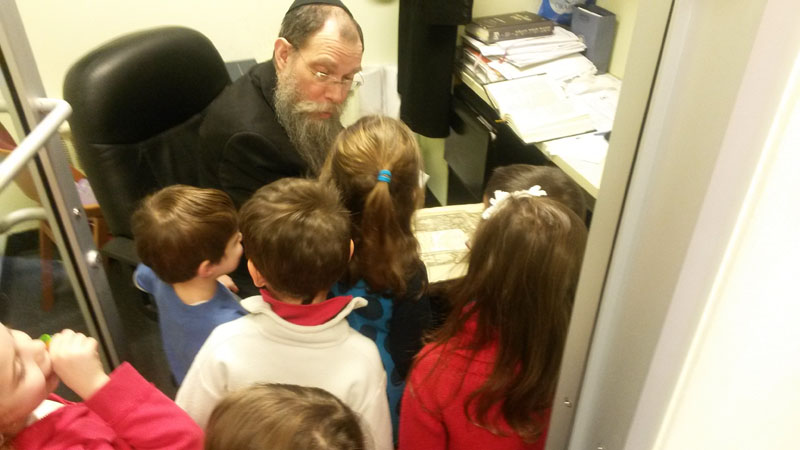
Then we "chugged" back into the classroom, where we discussed how we keep our Seforim/Jewish books in our living rooms, so when we sit and relax, we can also do the mitzvah of learning Torah. Then we pulled out our big Jewish Home posters to the tune of our Jewish Home song, and we furnished our living room. We also remembered that the living room is also a place where we welcome guests, the Mitzvah
of Hancasat Orchim that we learned about last week. We put a sofa, a coffee table, and a lamp in the room, along with a welcome mat to welcome our guests inside, and two bookcases for our Seforim! We are glad to have finally started filling the interior of our homes with the Mitzvot of Hashem.
FIRST GRADE
We started off with an exciting addition ot our classroom: new Siddurim, with p retty pictures and Tefilot we can follow! We all were really happy to try out the new prayerbooks.
We began to learn about TZEDAKAH. We explored this earlier in the year, and now we are taking up where we left off. We read a story how important it is to give Tzedakah, and then we discussed how we give Tzedakah? What are the ways we can help people? Is it only money? We figured out that there are many ways in which we can give Tzedakah: with money, with our time by volunteering, by giving things we have already like clothing or food, and with our personal talents.
We looked at the Pasuk in the Torah that teaches us about Tzedakah, and we realized that Tzedakah is not only a nice thing to do, but it actually is a commandment of G-d! Hashem asks us to take care of those who are poor, by sharing our food with them and caring for people who don't have other people to take care of them.
We wrote letters to people who are needy to give to them and try to make them happy, and we thought about ways in which we can help poor people. We learned that the word Tzedakah comes from the word that means right or righteous in Hebrew, and we thought about why is giving Tzedakah a right thing to do. We then thought of something righteous that were going to try to do from now on to help others.
SECOND GRADE
After a nice davening and a delicious snack, we reviewed what we learned last week.
We started to talk about the third dibra: Do not say Hashem's name in vain. We spoke how this includes not swearing while saying a lie, or swearing about obvious things in Hashem's name.
We thought about how we respect Hashem's name in other ways. We looked inside the siddur and the chumash, and we saw that Hashem's name is written differently than how we pronounce it. We discussed how Hashem's name is so holy, we don't ever pronounce it the way it is written. Instead we use the word "My Lord, Master", because its so special and secret. When we are not praying, we call G-d Hashem, because it's like a nickname referring to his real name. Hashem actually means, "The Name."
We read the book "In G-d's name" which talks about the many names people can call Hashem, depending on how they feel towards Hashem. We used pictures of different scenes to think about ways we can refer to Hashem.
We learned how we must also show respect for the printed form of Hashem's name in holy books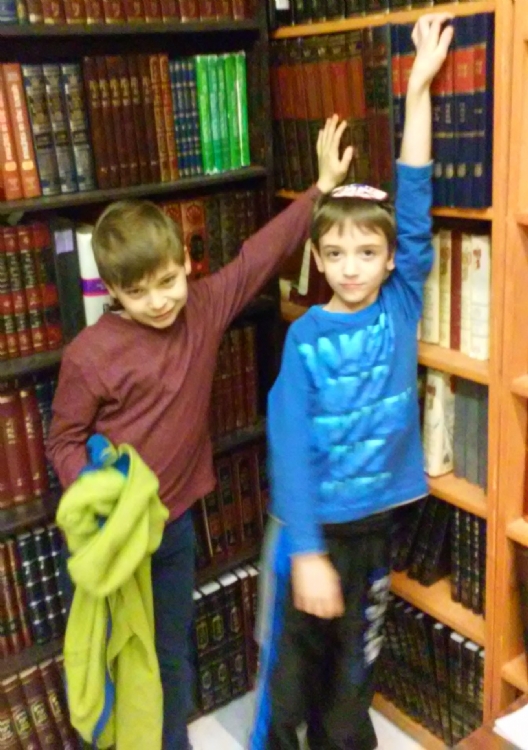 or in papers that have his holy name written on it. We discussed what are things we can do to show respect to sefarim: pick them up from the floor,
or kiss them when were done, arrange them in their proper order, right side up. We also learned that we treat old unusable sefarim or holy papers properly by burying them in the ground rather than throw them out. We place them in a special box called Geniza or Sheimot where all the holy papers are kept together till they can be buried. We saw a picture of a Geniza in Cairo, and we then visited our Chabad Sheimot box and looked through what was
kept inside.
or in papers that have his holy name written on it. We discussed what are things we can do to show respect to sefarim: pick them up from the floor,
or kiss them when were done, arrange them in their proper order, right side up. We also learned that we treat old unusable sefarim or holy papers properly by burying them in the ground rather than throw them out. We place them in a special box called Geniza or Sheimot where all the holy papers are kept together till they can be buried. We saw a picture of a Geniza in Cairo, and we then visited our Chabad Sheimot box and looked through what was
kept inside.
We went upstairs to the shul/library and checked to see if the sefarim were being treated nicely or if there was something we could fix, like turn over a book that was put on the shelf upside down.
When we got back to our class, we listened to a story of a Sefer Torah that was saved during the war. What a great day of learning!
THIRD GRADE
We are very excited about our new research project! Our class is using the Chumash and the Little Medrash says as our resources as we explore our assigned plague. We first read what the Torah says, and then we "fill in the blank spaces" with the Medrash Says.
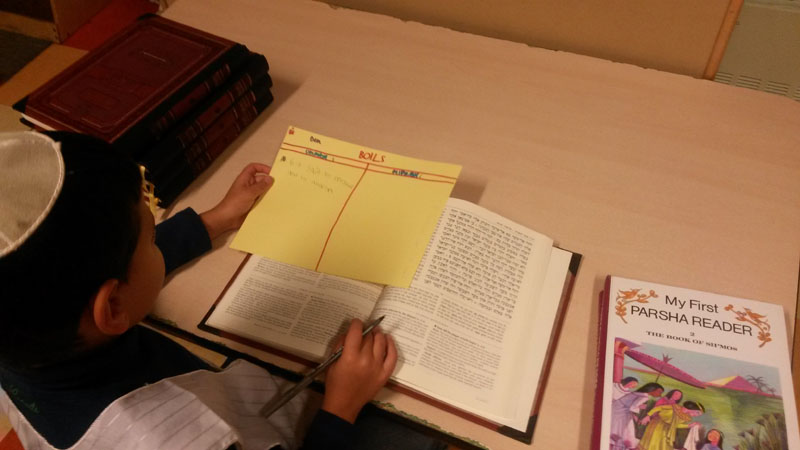 We are learning that different Rabbis had different ideas about what really happened, and get to wonder and be amazed alongside them! We wrote down the supplies that we would need to present it to the class and collected them. Next week, G-d willing, we will be presenting them to the class!
FIFTH GRADE
This week we were introduced to the first Jewish king: King Shaul. Hashem sent Shmuel the prophet to annoint him. Although Hashem had already chosen who the king was going to be, Hashem told Shmuel to make a lottery. This way, nobody can argue that Shmuel chose Shaul because of personal preference.
The students predicted Shaul's reaction: excited and nervous. T hey were surprised to discover that Shaul was not even present! Although his appearance was quite kingly, he was especially tall and handsome, he was also very humble. He did not feel worthy of being the king. We took a poll whether or not humility is a good trait for a king. In a way, it's good because he doesn't care about his own
power and he is completely focused on the people. On the other hand, when a person is humble, he may not have the confidence to do what is required of him, and humility can also be percieived as meekness and insecurity. King Shaul's humility was his greatest strength and weakness at the same time. We learned that all characteristics can be good or bad. Eventually, Shaul lost his kingship because of this trait.
During Shaul's rule, the Jews were attacked by Amalek. Amalek is the nation that is always first to attack. We brought in a cup of boiling water to serve as an analogy. At first, the students apprehensively dipped the tip of their finger but quickly pulled away. One student daringly dipped his whole fist in. The next student immediately followed suit. This was Amalek: always first to jump in and
attack the Jews, and pave the way for others to copy. We also started focusing on learning more brachot from the Amidah. It was really exciting to start saying it quietly to ourselves. We took the time to read the words carefully and we will continue learning more of the Amidah in the coming weeks.


 More...